
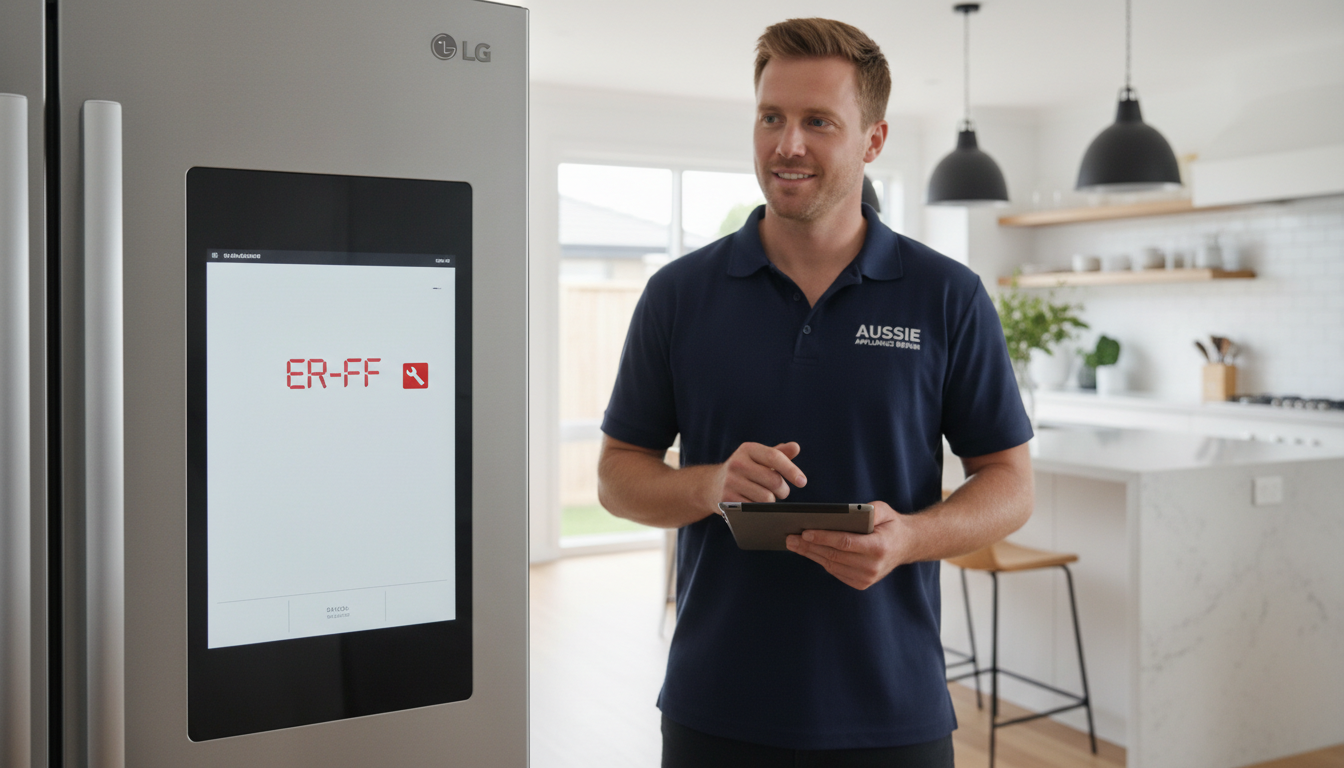
When your LG fridge displays a fault code on its control panel, the appliance’s self-diagnostic system has detected a component failure that affects cooling performance or energy efficiency. For Sydney homeowners searching for LG fridge repair Sydney services, understanding what each error code means helps you determine whether the fault requires immediate professional attention or if safe preliminary checks can resolve the issue. LG refrigerators use alphanumeric fault codes to identify specific failures in fan motors, defrost systems, thermistors, and communication circuits between the main PCB and component assemblies.
This diagnostic guide explains the most common LG fridge fault codes, the electrical and mechanical component failures behind each error, and when same-day fridge repair becomes necessary to prevent food spoilage or compressor damage. Sydney Appliance Services provides same-day diagnostic and repair service across Greater Sydney suburbs including Parramatta, Penrith, Liverpool, Campbelltown, Bankstown, Sutherland Shire, Northern Beaches, North Shore, Inner West, and Eastern Suburbs, using genuine LG-compatible parts backed by a 12-month repair warranty.
Why LG Fridges Display Fault Codes
LG refrigerators incorporate a self-diagnostic system that continuously monitors component operation through sensors connected to the main PCB. When the control board detects voltage irregularities, temperature readings outside normal parameters, or failed communication with component circuits, it logs a fault code and displays it on the control panel. This diagnostic system serves three purposes: it alerts you to component failures before complete cooling loss occurs, it helps technicians identify the exact failed part without extensive testing, and it protects the compressor from damage caused by defrost system faults or fan motor failures.
The diagnostic system monitors thermistor sensors that measure compartment temperatures, fan motors that circulate air across evaporator coils, defrost heaters that prevent ice buildup on cooling coils, and communication circuits between the main control board and component assemblies. When any monitored component fails to operate within programmed parameters, the PCB triggers a fault code. Similar to common fault patterns in modern refrigerators from other manufacturers, LG’s error codes typically indicate specific component failures rather than general system malfunctions.
By the Numbers
- STATChoice reports that refrigerators have an expected lifespan of 7-10 years in Australian households, with component failures like fan motors and defrost systems being the most common repair needs after 5 years.
- STATAccording to Energy Rating Australia, a malfunctioning fridge can consume up to 30% more electricity than normal operation, with defrost system faults being a primary cause of increased energy use.
Error Code: Er IF (Ice Fan Fault)
The Er IF code indicates a failure in the ice maker fan motor or its control circuit. This fan circulates cold air from the freezer compartment to the ice maker assembly, maintaining the temperature required for proper ice production. When the main PCB detects that the ice fan motor is not drawing expected current or is not responding to control signals, it triggers the Er IF fault code.
Common causes include a seized fan motor bearing due to ice buildup around the fan housing, a failed motor winding that prevents rotation, or a damaged wiring harness connection between the fan motor and the main control board. In some cases, the fault relates to the PCB’s fan control relay rather than the fan motor itself. This error often presents alongside symptoms of a fridge not cooling but still running, as the compressor continues operating while air circulation fails.
Safe homeowner checks include inspecting the ice maker compartment for visible ice buildup that might obstruct the fan, listening for unusual motor sounds when the ice maker cycles, and verifying that the freezer compartment is maintaining proper temperature. If ice buildup is present and accessible, you can defrost the area by unplugging the fridge for several hours, but do not attempt to remove panels or access internal fan components.
Error Code: Er FF (Freezer Fan Fault)
The Er FF code signals a failure in the freezer evaporator fan motor, which circulates air across the evaporator coils and throughout the freezer compartment. This fan is critical to maintaining consistent temperature distribution and preventing ice buildup on the evaporator coils. When the PCB detects that the freezer fan motor is not operating or is drawing abnormal current, it logs the Er FF fault code.
The most common cause is a worn fan motor bearing that produces grinding or clicking sounds before complete failure. Other causes include a failed motor capacitor that prevents the motor from starting, ice accumulation around the fan blade that prevents rotation, or a broken fan blade that creates imbalanced operation. Fan motor faults typically present with unusual fridge noises and their causes including grinding, squealing, or intermittent clicking as the motor attempts to start.
When the freezer fan fails, you will notice uneven cooling with warmer temperatures near the top of the freezer compartment, frost buildup on the rear panel where the evaporator coils are located, and increased compressor run time as the system attempts to compensate for poor air circulation. The freezer may still produce some cooling, but temperature consistency will be compromised and food quality will deteriorate.
Before calling a technician, check whether you can hear the fan motor running when the compressor is operating. Open the freezer door and listen for a quiet whirring sound from behind the rear panel. If you hear grinding or clicking, the motor bearing has likely failed. If you hear nothing, the motor or its control circuit has failed completely. Do not remove the rear panel to inspect the fan, as this requires disconnecting electrical connections and may expose you to sharp evaporator coil fins.
Error Code: Er dH (Defrost Heater Fault)
The Er dH code indicates a failure in the defrost heater element or its control circuit. LG refrigerators use an automatic defrost system that periodically activates a heating element mounted beneath or around the evaporator coils to melt accumulated frost. When the main PCB detects that the defrost heater is not drawing current during a scheduled defrost cycle, or that the heater circuit shows an open or short condition, it triggers the Er dH fault code.
Common causes include a burned-out heater element due to age or manufacturing defect, a failed defrost thermostat that prevents power from reaching the heater, or a faulty defrost control relay on the main PCB. When the defrost heater fails, ice accumulates on the evaporator coils over successive cooling cycles. This ice buildup blocks airflow across the coils, reducing cooling efficiency and forcing the compressor to run continuously. If left unrepaired, defrost system faults lead to compressor failure diagnosis and repair as the compressor overworks attempting to maintain temperature despite blocked airflow.
Symptoms of defrost heater failure include excessive frost or ice buildup on the freezer rear panel, reduced cooling performance in both freezer and refrigerator compartments, and increased energy consumption as the system runs longer cycles. You may also notice water pooling at the bottom of the freezer compartment if ice buildup eventually melts during compressor off-cycles.
Defrost heater replacement requires removing the rear freezer panel to access the evaporator coil assembly, disconnecting the heater element from its wiring harness, and testing the defrost thermostat and control relay to ensure the entire defrost circuit is functioning correctly. This repair must be performed by a qualified technician, as it involves working near refrigerant lines and electrical components in a confined space.
Error Code: Er DS (Defrost Sensor Fault)
The Er DS code signals a failure in the defrost sensor, also called the defrost thermistor or defrost temperature sensor. This component monitors the temperature of the evaporator coils and signals the main PCB when the coils have reached the temperature required to end the defrost cycle. When the PCB detects that the defrost sensor is providing readings outside the expected range, showing an open circuit, or displaying erratic resistance values, it logs the Er DS fault code.
Common causes include a failed thermistor element that no longer changes resistance with temperature, damaged wiring between the sensor and the main control board, or corrosion on the sensor connector terminals due to moisture exposure. A failed defrost sensor prevents the control system from accurately managing defrost cycles. If the sensor reads too cold, the defrost heater may run excessively, wasting energy and potentially overheating components. If the sensor reads too warm or shows an open circuit, defrost cycles may terminate prematurely, leaving ice on the evaporator coils.
Symptoms include inconsistent defrost cycle timing, ice buildup on evaporator coils despite the defrost heater functioning correctly, or excessive condensation in the freezer compartment if defrost cycles run too long. The fridge may also display temperature fluctuations as the control system struggles to maintain consistent cooling with inaccurate sensor data.
Defrost sensor testing requires accessing the sensor location near the evaporator coils and measuring its resistance at various temperatures using a multimeter. Replacement involves disconnecting the sensor from its mounting clip and wiring harness, then installing a new sensor with the correct resistance specification for your LG model. This component is relatively inexpensive, but accessing it requires removing freezer panels and working near refrigerant lines.
Error Code: Er rF (Refrigerator Fan Fault)
The Er rF code indicates a failure in the refrigerator compartment fan motor or its control circuit. This fan, typically located at the top or rear of the refrigerator section, circulates cold air from the freezer compartment through a duct system into the refrigerator compartment. When the main PCB detects that the refrigerator fan motor is not operating or is drawing abnormal current, it triggers the Er rF fault code.
Common causes include a seized fan motor bearing, a failed motor winding, ice buildup in the air duct that prevents fan blade rotation, or a damaged wiring connection between the fan motor and the control board. When the refrigerator fan fails, the refrigerator compartment will not receive adequate cold air circulation, resulting in warmer temperatures in the fresh food section while the freezer continues to operate normally.
Symptoms include warm temperatures in the refrigerator compartment despite the compressor running, frost buildup around the air duct opening between freezer and refrigerator sections, and uneven cooling with colder temperatures near the air duct and warmer temperatures near the door. You may also hear grinding or clicking sounds if the fan motor bearing is failing.
Safe homeowner checks include listening for fan operation when the compressor is running and the refrigerator door is closed, checking for visible ice buildup around air vents inside the refrigerator compartment, and verifying that the freezer is maintaining proper temperature while the refrigerator is warm. If ice buildup is blocking the air duct, you can attempt to defrost the fridge by unplugging it for several hours, but do not remove panels or attempt to access the fan motor.
Error Code: Er CO (Communication Error)
The Er CO code signals a communication failure between the main control board and one or more component control boards within the refrigerator system. Modern LG refrigerators use multiple PCBs that communicate via serial data connections to coordinate compressor operation, fan control, defrost cycles, and display functions. When the main PCB cannot establish or maintain communication with a component board, it logs the Er CO fault code.
Common causes include a loose wiring harness connection between control boards, a failed component PCB that no longer responds to communication signals, corrosion on connector terminals, or a fault in the main control board’s communication circuit. This error can also occur after a power surge that damages control board components or after incorrect reassembly following a previous repair.
Symptoms vary depending on which component board has lost communication. You may experience complete loss of cooling if the compressor control board is affected, loss of display functions if the user interface board is affected, or loss of specific features like ice making or water dispensing if those component boards are involved. In some cases, the fridge may continue operating in a default mode with reduced functionality.
Before calling a technician, you can attempt to reset the communication system by unplugging the fridge for 60 seconds, then reconnecting power. This allows all control boards to reinitialize their communication protocols. If the Er CO code reappears after reset, a physical component or wiring fault requires professional diagnosis. Do not attempt to access control boards or wiring harnesses yourself, as this involves working with mains voltage connections.
What to Do When Your LG Fridge Shows a Fault Code
When your LG fridge displays a fault code, your immediate response should focus on protecting stored food and documenting the fault for technician diagnosis. The immediate steps when your fridge displays an error determine whether food remains safe and whether the fault requires urgent same-day repair.
- ✓
Check if the fault code is displayed continuously or intermittently — intermittent codes often indicate loose wiring connections rather than complete component failure. - ✓
Note any accompanying symptoms: unusual noises, ice buildup, temperature fluctuations, or water pooling inside compartments. - ✓
Verify the fridge is level using a spirit level — an unlevel fridge can trigger false door sensor errors and affect defrost cycle timing. - ✓
Inspect door seals for gaps or damage — poor seal contact can cause the compressor to overwork and trigger temperature-related fault codes. - ✓
Clear any ice buildup from vents and fan areas if safe to access — blocked airflow can trigger fan fault codes even when motors are functional. - ✓
Record the exact fault code and how long it has been displayed — this information helps technicians prepare the correct replacement parts for same-day repair.
After documenting the fault code and symptoms, you can attempt a system reset by unplugging the fridge for 60 seconds or by holding the refrigerator and ice plus buttons simultaneously for 5 seconds. This reset clears temporary faults and allows the control system to reinitialize. However, if the underlying component failure remains, the fault code will reappear within minutes to hours of operation.
Monitor compartment temperatures using a fridge thermometer. The refrigerator compartment should maintain 3-4°C and the freezer should maintain -18°C. If temperatures rise above these ranges and the fault code persists after reset, arrange same-day professional repair to prevent food spoilage. Under the Australian Consumer Law (ACL) Schedule 2 of the Competition and Consumer Act 2010 (Cth), persistent faults that prevent the appliance from performing its primary function indicate a failure to meet the statutory guarantee of acceptable quality, and you may have rights to free repair even outside manufacturer warranty periods.
When to Call a Professional for LG Fridge Fault Codes
Certain fault codes indicate urgent cooling system failures requiring immediate professional attention. Understanding when same-day fridge repair becomes essential helps you protect stored food and prevent secondary damage to expensive components like the compressor.
Call a qualified refrigeration technician immediately if the fault code persists after reset, if compartment temperatures rise above safe food storage ranges, if you hear unusual grinding or clicking sounds from fan motors, or if ice buildup is visible on evaporator coils or air ducts. These symptoms indicate component failures that will not resolve without physical repair.
Fan motor faults (Er IF, Er FF, Er rF) require same-day attention because failed air circulation causes uneven cooling and forces the compressor to run continuously, increasing energy consumption and accelerating compressor wear. Defrost system faults (Er dH, Er DS) require prompt repair because ice accumulation on evaporator coils progressively reduces cooling efficiency and can lead to complete cooling failure within days.
Communication errors (Er CO) may allow the fridge to continue operating in a limited capacity, but should be diagnosed within 24-48 hours to prevent unexpected complete failure. If the error affects compressor control or defrost timing, immediate repair becomes necessary.
Professional diagnosis involves testing component electrical circuits with a multimeter, measuring thermistor resistance values at specific temperatures, inspecting wiring harnesses for damage or corrosion, and verifying that the main PCB is sending correct control signals to component circuits. Technicians carry diagnostic equipment and genuine replacement parts for same-day repair completion in most cases.
LG Fridge Repair Sydney: Same-Day Service Across Greater Sydney
Sydney Appliance Services provides same-day LG fridge fault code diagnosis and repair across all Greater Sydney suburbs. Our mobile technicians carry genuine LG-compatible replacement parts including evaporator fan motors, defrost heaters, thermistor sensors, door gaskets, and control board components, enabling same-day repair completion for most fault codes.
We service LG refrigerators in Parramatta, Penrith, Liverpool, Campbelltown, Bankstown, Sutherland Shire, Northern Beaches, North Shore, Inner West, Eastern Suburbs, Blacktown, Castle Hill, Ryde, Canterbury-Bankstown, Fairfield, and all surrounding areas. Our technicians arrive with diagnostic equipment to test fan motors, defrost circuits, thermistor sensors, and control board communication systems, providing accurate fault identification and upfront repair quotes before commencing work.
All LG fridge repairs are backed by a 12-month warranty covering parts and labour. We use genuine LG-compatible components that meet original equipment specifications for voltage, current draw, and temperature ratings, ensuring reliable long-term performance. Our technicians provide detailed explanations of fault causes and repair procedures, helping you understand what failed and how to prevent similar issues.
For urgent fault codes affecting cooling performance, we prioritize same-day service to minimize food spoilage risk and prevent secondary damage to compressor systems. Our mobile service eliminates the need to transport your fridge to a repair workshop, and we complete most repairs within 60-90 minutes of arrival.
Frequently Asked Questions
Can I reset my LG fridge to clear a fault code?
You can reset most LG fridges by unplugging for 60 seconds or holding the refrigerator and ice plus buttons simultaneously for 5 seconds. However, if the underlying component fault remains unrepaired, the code will reappear. Under the Australian Consumer Law (ACL) Schedule 2 of the Competition and Consumer Act 2010 (Cth), persistent faults within the reasonable lifespan indicate a failure to meet the statutory guarantee of acceptable quality. Repeated resets without addressing the component failure can lead to secondary damage, particularly to the compressor if fan motors or defrost systems remain faulty. Professional diagnosis identifies the specific failed component rather than temporarily masking symptoms through reset procedures.
How much does LG fridge fault code repair cost in Sydney?
Repair costs vary by fault: fan motor replacements typically range $180-$320, defrost heater repairs $150-$280, and thermistor sensor replacements $120-$220 including parts and labour. Sydney Appliance Services provides upfront quotes and same-day service across Greater Sydney with genuine LG-compatible parts. Communication error diagnosis may involve control board replacement ranging $280-$450 depending on which board has failed. These costs represent significantly better value than replacement, as new LG refrigerators cost $1,200-$3,500. Under your right to repair under ACL, component failures within reasonable lifespan expectations should be repaired rather than requiring full appliance replacement, particularly for appliances under 7 years old.
Are LG fridge fault codes covered under warranty?
LG typically provides 2 years parts and labour warranty, with 10 years on sealed refrigeration systems (compressor). Beyond manufacturer warranty, your right to repair under ACL continues for the reasonable expected lifespan of the appliance, which Choice suggests is 7-10 years for refrigerators. Fault codes indicating manufacturing defects may qualify for free repair even outside standard warranty periods. The Australian Competition and Consumer Commission (ACCC) advises that consumers can pursue repair rights through NSW Fair Trading when manufacturers refuse warranty claims for faults occurring within reasonable lifespan expectations. Component failures like fan motors, defrost heaters, and thermistor sensors within 5-7 years typically indicate quality issues rather than normal wear, strengthening your claim under the statutory guarantee of acceptable quality.
Why does my LG fridge keep showing the same error code after reset?
Recurring fault codes indicate an unresolved component failure that requires physical repair, not just a reset. Common causes include failed thermistors providing incorrect temperature readings, worn fan motors with bearing failure, or defrost system components with electrical faults. Professional diagnosis identifies the specific failed component rather than masking symptoms through repeated resets. The LG diagnostic system continuously monitors component operation, and when sensors detect voltage irregularities, temperature readings outside normal parameters, or failed communication with component circuits, the fault code reappears. Sydney Appliance Services technicians use multimeter testing and component resistance measurements to identify exact failure points, ensuring permanent repair rather than temporary symptom suppression.
If your LG fridge is displaying a fault code, Sydney Appliance Services provides same-day diagnostic and repair service across all Greater Sydney suburbs. Our technicians carry genuine LG-compatible parts and provide a 12-month repair warranty. Contact us today for fast, expert LG fridge repair Sydney homeowners trust.
Same-day service available across Greater Sydney. Genuine parts. All repairs backed by warranty. We come to you.